
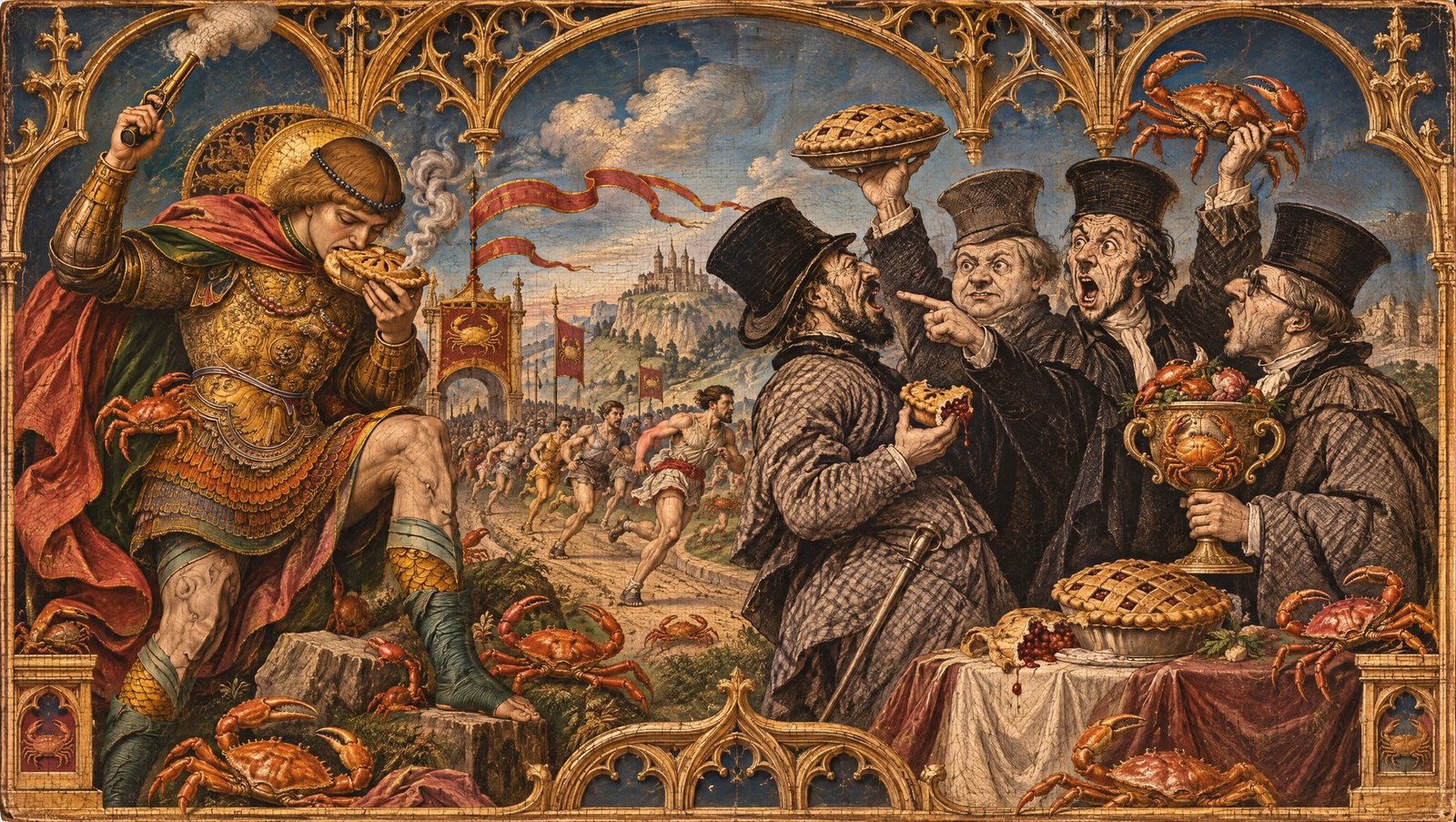
Reliquaries of the Forgettable
Every voice in the room adds a compromise, and the result is forgettable. On taste versus craft, the rules worth breaking, and why work designed by many and owned by no one fails the business that paid for it.
Read by Charlie, an AI voice.
The argument was about blue. One person at the table wanted cerulean, another wanted teal, and the difference between the two, on a promotional postcard, was the kind most people walking past a mailbox would struggle to see. Somewhere in the middle of it, someone asked for three exclamation points at the end of the headline. Someone else asked for the type to be as big as it could possibly go, so nobody could miss it. Every request was sincere, and every one was small. I have sat at that table, or one just like it, more times than I can count, and I can tell you how the meeting ends.
All this entropy over a postcard.
HOW A GOOD IDEA DIES
It doesn’t die of one bad decision. It dies of reasonable ones. A design isn’t a pile of separate choices; it is a web of them, each holding the others in place. The size of the headline was chosen against the size of the photograph and the white space around both. The color was chosen against everything else on the card. Ask for bigger type, and the headline crowds the image, the margins shrink, and the one thing meant to stand out now competes with everything around it. Add three exclamation points, and you’ve announced that the sentence is urgent, which is another way of admitting it couldn’t make its case alone. When everything shouts, nothing is heard.
Each change looks harmless from the chair of the person who asked for it. Together they drag every decision toward the middle of the table, and the middle of the table is where good ideas go to be forgotten. That is the arithmetic of a committee. You can’t average your way to good work.
I should be fair to the people around the table, and honest about where I’m sitting. It’s their money and their name on the card, and wanting a say in it is the most natural thing in the world. I’m the designer, so of course I think the designer should decide. But I’ve also watched what happens when the designer doesn’t, and the evidence is in a lot of drawers.
TASTE IS NOT CRAFT
The hardest part of the job is rarely the work. It’s working with people who believe they could do it themselves. Everyone has taste, and they aren’t wrong to trust it; taste is how you recognize a good haircut. Craft is knowing how to give one. Hiring a designer and then directing every cut is like hiring a hairstylist and cutting your own hair anyway, with one mirror and dull scissors, while the professional stands there holding the comb. The distance between taste and craft is invisible from the near side. From inside the box of your own perceptions, the walls look like windows.
What separates them is execution. A mediocre idea carried out with skill will stand on its own two feet. A brilliant idea fumbled on its way from the mind to the page will fall over. I’ve spent most of my working life on the second half of that sentence, learning to carry an idea all the way into the world without dropping it, and it is the half a committee can’t see.
RULES WORTH BREAKING
Good design runs on rules that look arbitrary until you break one by accident. Lines of text that run too long wear out the eye. A headline needs room around it to be read as a headline. Two colors that are almost the same look like a printing mistake rather than a choice. None of these rules came out of a meeting. They came from generations of printers, painters and typographers discovering what the eye will follow and what it won’t. The masters learned them well enough to break them on purpose: Picasso could draw with academic precision as a teenager, long before he took perspective apart. A rule broken on purpose is a decision. A rule broken by committee is an accident with a dozen signatures on it.
THE RIVER
The work itself happens in a state psychologists call flow and artists call the zone. In it, you’re moving down a river. Decisions build on decisions, your hands know the next move before you’ve named it, and you stop seeing the destination. You see only the next bend, and you’re sure of it. Flow can’t survive interruption, and a committee is built out of interruptions: the email asking for an update, the meeting about the meeting, this week’s feedback reversing last week’s. Each one costs more than it looks like it costs. Enough of them, and the river is a row of puddles.
ONE TUBE OF RED
Then there are the tools. Give a painter one tube of red and she can still make something. Give her the whole palette, with gold leaf and new brushes and clay besides, and her options don’t add up; they multiply, and so does what she can imagine. Someone designing a postcard in Microsoft Word is painting with one tube of red. Word was built for letters and reports: left to right, top to bottom, a handful of alignment choices, little control over spacing, generic fonts and a color picker that seems designed to discourage color. The file it makes isn’t ready for a printing press, and the design is a prisoner of the program before its first decision.
Limits aren’t always the enemy. Henry Mancini wrote “Moon River” to fit Audrey Hepburn’s modest singing range, and the limit became the song’s grace. The question is whether a constraint serves the work or smothers it. A table of people working in familiar tools, gathering every opinion in reach, believes it is assembling the best possible input. It has already lost. It just hasn’t started yet.
THE OTHER KIND OF ROOM
Collaboration isn’t the problem. Some of the best work in every medium has come from partnerships and small crews, and the ones that worked share a few things: years of common vocabulary, and a trust so settled that nobody has to say it out loud. Nobody second-guesses an instinct that has proved itself a hundred times. You finish each other’s visual sentences. No org chart can manufacture that; it grows, or it doesn’t. A committee is the opposite arrangement, people with different agendas and different ideas of success, each pulling a little away from the others, until the work settles wherever all the pulls cancel out.
WHAT IT COSTS
This isn’t a craftsman’s grievance. Business is more than quantities and margins. At some point a stranger has to see more value in a thing than they’re being asked to pay for it, and the only reliable way to get them there is work that makes them feel something strong enough to act. Perceived value has to exceed cost. Work designed by many and owned by no one moves nobody, so it can’t open that gap. It sits in the world like a relic nobody visits, enshrined by the people who paid for it. Reliquaries of the forgettable. It fails the business that commissioned it. It fails the idea that started it.
It fails.
I’ve held this conviction too long to expect it to change. When the work goes right, when the rules have been learned and then broken on purpose, when the river runs without interruption and the hands are trusted, the reward is its own justification. The work earns its place in the world and keeps it, and that doesn’t dull with the years.
As for the postcard, whichever blue wins, it will go to print with three exclamation points and very large type, and nobody will remember which blue it was. The cerulean compromise will live and die in a drawer. Somewhere else, the real work continues.
The short version
- A design is a web of decisions that hold each other in place. A committee’s reasonable requests (bigger type, a different blue, more exclamation points) pull each one toward the middle, and the middle is forgettable. You can’t average your way to good work.
- Taste isn’t craft. Good work comes from rules learned well enough to break on purpose, real tools, and long stretches of uninterrupted focus, which a committee’s interruptions destroy.
- It’s a business problem, not a designer’s grievance: work only sells when it moves people, and work designed by many and owned by no one moves no one.