
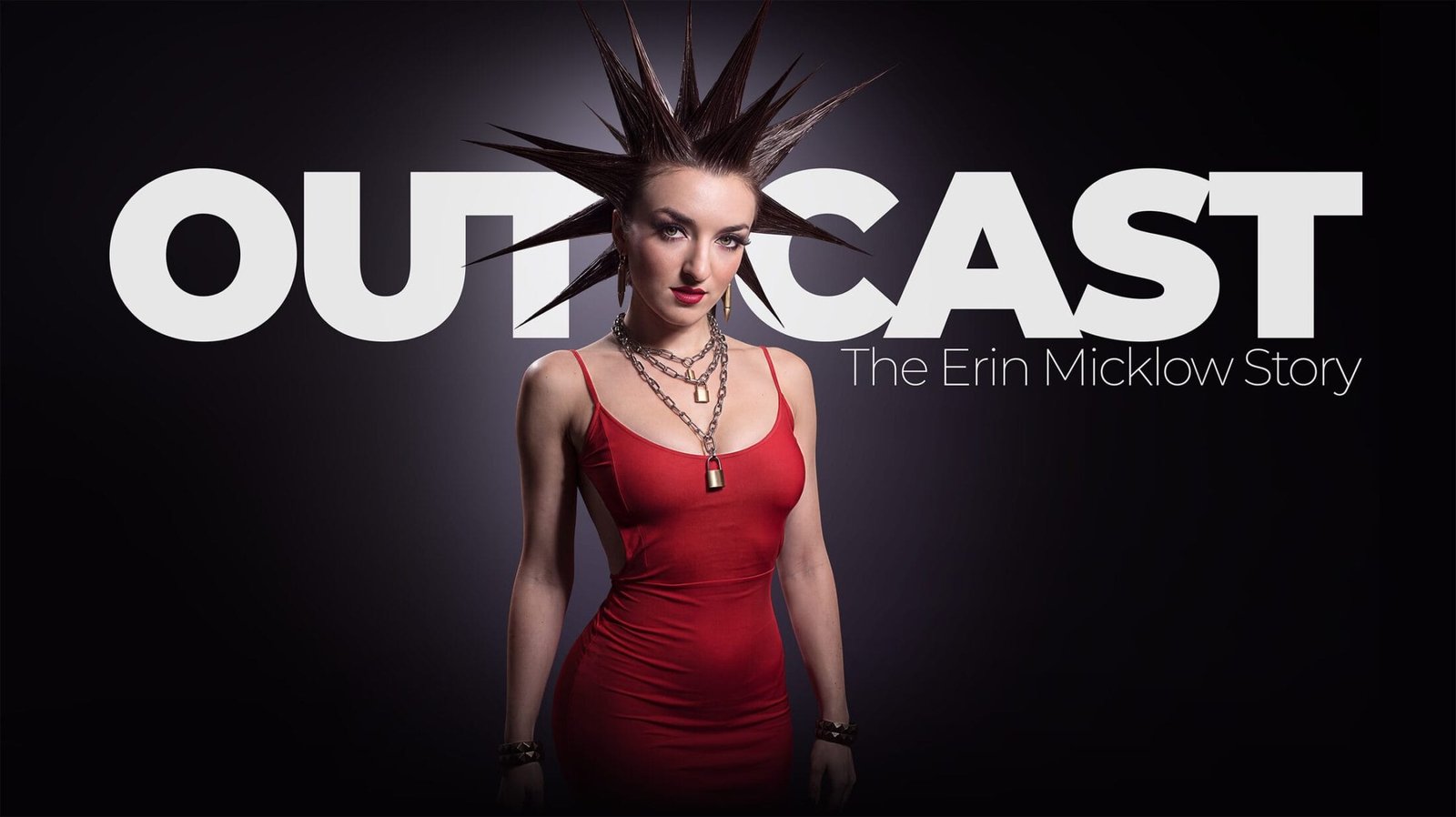
Erin Micklow: Liberty Spikes and the Night Punk Turned on Her
A pin-up model, a punk scene, and the hairstyle that came between them
By her own account, the woman who came up to Erin Micklow in the women’s restroom of the Moroccan Lounge, in Los Angeles, on the night of Saturday, April 27, 2024, looked like she was about to fall over. She held out a sticker. Erin took it with a smile, assuming it was band merchandise, and found herself looking at her own face. The message beside it, as she remembers it, ran along the lines of: posers get out of our scene.
At twelve, Erin went through an American rite of passage for girls who want to model: Barbizon. She and her mother came to regard it as a hustle, but the ambition outlived the disillusionment. Acting classes and modeling agencies in Florida followed, and by the time she was fourteen, the search had a national itinerary. Her mother took her to New York and to Los Angeles to see whether the ambition could become work.
Los Angeles took. After a summer of acting classes, casting-director workshops, and agency meetings, she came home with one sentence: “Mom, I want to move here. I want to do this, like, for real.” Her mother supported it but wasn’t going to uproot her own life; Erin would have to wait until she was eighteen. Home, meanwhile, was Tampa: six years of Catholic school in what she later called “redneck Florida,” and a big brother with a copy of Green Day’s Dookie. Florida was not much of a scene. “The summer tours would come through,” she said, “and that was about it.”
In tenth-grade geography, punk arrived in the seat behind her, on a boy whose vest carried a large patch across the back that read “Unseen.” When the band came to town, her friend couldn’t go, so Erin went alone. “I think what got me hooked on that first show was I was alone but didn’t feel alone,” she said. “It was fairly easy to make friends at the show too, which seemed so difficult for me everywhere else.”
She waited. When she graduated, her mother laid out the choice: there was money saved for college, and there was Los Angeles, and she couldn’t afford both. “And I said LA.”
WELCOME TO LA
She arrived in the summer of 2007, two days after her high-school graduation, with her mother’s blessing and her mother along to help find an apartment. Her mother supplied some cash and a place to live; making a life there was Erin’s job. Her first was behind the counter of a frozen-yogurt shop. She either didn’t recognize the cliché or didn’t care. She was eighteen, the age at which a one-in-ten-thousand shot and a sure thing feel equally likely.
Luck arrived in a distinctly 2007 form. The afternoon she toured her first apartment, she ran into a punk fan who happened to be one of her MySpace contacts, and she pressed her mother to sign the lease. In a city that size, a familiar name was worth a lease.
The trouble started just as fast. “The haters started right away,” she said. “This was around the time when Hellcat Records was really big and doing a lot of releases, really pushing their bands, and this woman, she worked for a Hellcat band. She lived in the apartment downstairs, and to be honest, she was just a total c-word to me from the beginning. They keyed my car, and they just harassed me for years in LA, and it was just no reason at all. Just people being catty. And so that was it: hi, welcome to LA, and here’s the punk scene.”
It was her introduction to an old contradiction. Punk began by throwing out the old judges of taste and then appointed its own: connections to the right bands and labels conferred status, and belonging could be turned into a way of keeping people out. Even nonconformity had acquired a dress code. The polish Erin kept up for auditions read to some people as the wrong uniform, though nothing about it made her love of the music less sincere. A person can live in two worlds without belonging wholly to either. Scenes are not always willing to see it.
Her early screen work was in another register altogether: a local television credit as “Bikini Vampiress,” then more acting through 2010. In 2011, the camera brought her two lives together. Hosting for Rebel Music TV at the Las Vegas Shakedown festival, she conducted her first on-camera punk interviews, and in documenting the musicians she admired she began to become one of the scene’s chroniclers, neither quite an outsider nor quite an insider. Not everyone welcomed her. She kept coming back.
Around 2011, she also began making an annual pilgrimage to Punk Rock Bowling, the Las Vegas reunion that pairs a concert lineup with bowling lanes. Year after year, acquaintances became friends, and conversations picked up where they had left off; by the time she started interviewing musicians, she was approaching a community in which she already had a history. Onstage, the founders shared a bill with their heirs, and the scene watched its own succession from the floor. A weekend that gathered everyone into one crowd also sorted them by where they stood in it: the bands, the friends of the bands, the regulars, and everyone else. Erin’s place in that order was secure, for the moment.
THE SPIKES
In or around 2012, Erin married. In Germany, a Distillers poster hung on the wall of her husband’s room, and from it Brody Dalle stared back: spiked hair, tattoos, piercings, and the bearing of a woman who had never asked anyone’s permission. “I want to have cool punk hair,” Erin remembered thinking. It was the moment a band she loved became something she wore. Her husband spiked her hair the way Dalle wore hers, then taught her to do it herself. Even then she bargained with the camera. A mohawk, she explained, “would limit the jobs that I would be able to do.” Liberty spikes could come down for an audition and go back up for a show.
They gave her a signature silhouette, severe geometry around the composure of a studio portrait, punk’s aggression and the polish of her modeling work in a single frame. The scene took note. In August 2018, the Arizona music blog Every Show Joe introduced her this way: “If you have been around the national punk scene in recent years, you have probably spotted Erin Micklow. Either her spiked hair roaming around Punk Rock Bowling, on her YouTube channel, or just with a search of punk social media. Social media brings out the critics and the praise.” A year later, at the Rebellion Festival, Devolution Magazine‘s Gary Trueman put it plainly: “You’re well known on the punk scene for those amazing liberty spikes and your custom outfits. So let’s deal with the hair first.” Earlier in the same conversation, she had told him how the punk and the pin-up came together. “I was a punk before I was a pin-up model,” she said. “I was still a punk rocker when I was pin-up modelling.” Modeling that way, she added, “wasn’t accepted at first but then it did get accepted, and it became a way for me to get jobs.”
The numbers tell the rest. Pull a random handful of her YouTube Shorts and the spikes turn up in about one in four; the rest are outfits, travel, bikinis, and brand deals, her hair down. The audience was not choosing at random. Fewer than one in thirty of her Shorts is about her hair, yet those videos have drawn nearly two of every three views, on average more than fifty times what her other Shorts get. On TikTok, the pattern holds: the spikes videos, fewer than one in five of her most-watched, account for two-thirds of their views. Her single biggest, 21 million plays, is her fixing the spikes after sleeping on them. A hair-product brand, got2b, put her spikes in its print ads. Only on Instagram is the picture mixed. She made more than a hundred videos about them. Some would call that taking advantage. Most people, handed a key like that, would use it.
She knew it. “I do change my hair often,” she told viewers in 2022, “even though I am most known for my liberty spikes.” That spring, launching a new business, she let them down for a month. “A lot of my followers got really mad at me for that,” she said, “so I lost a bunch of followers because I didn’t have my hair spiked.” When she wore it any other way, people were “really angry that I don’t look like this 100 [percent] of the time.” She had chosen the spikes because they could come down. Her audience never let them.
The work multiplied. She walked the runway at Viva Las Vegas and landed roughly twenty-five magazine covers as a pin-up, doing her own hair, makeup, and wardrobe, and she built a second career as a stylist and image consultant. She wrote fashion columns, styled the cast of The Little Rascals for their twentieth-anniversary reunion and the Lost Boys of Hook for their twenty-fifth, both of which drew national press. She met Iggy Pop while competing in a festival pin-up contest, went to Riot Fest, went to Coachella as Rancid’s guest, and went with Mickey Leigh to the opening of the Grammy Museum’s Ramones exhibit. She launched Last Rockers TV on YouTube by sheer persistence, interviewing the Aggrolites, Good Riddance, and the Adolescents, whose “L.A. Girl” was a personal favorite. At the Rainbow, she gave Lemmy a pin with her picture on it; he put it on his vest and, by her account, wore it until his final days. And every spring brought her back to Punk Rock Bowling.
LAS VEGAS
Then came 2018.
What follows is her account of that Memorial Day weekend. Las Vegas had been her destination for eight years running. That spring, the organizers at first turned down her media requests and relented only when an industry colleague vouched for her coverage. She arrived, she said, with “a bad feeling.” Encouraged by her husband to be “the bigger person,” she approached Shawn Stern, the festival’s co-founder, thanked him for the press access, and praised the event. Their history was complicated. In 2009, when she was twenty-one and he was fifty, they had a brief personal connection, a period in which she has said she felt her youth had been exploited. A mutual acquaintance later told her that Stern hadn’t known she had been approved until she thanked him. After that, she said, “he made it his mission to have me removed from his festival.”
An associate revoked her credentials and her husband’s, alleging that she had filmed backstage despite earlier warnings. Erin called it “a brazen lie” and said she would gladly have shown her camera rolls to settle it. No one, she said, checked. Ejected from the grounds, the couple came back later and were detained and walked out through the entrance by security and four uniformed officers. That evening, at an off-site venue where a band was expecting her to film, staff were waiting for her with three officers, and a ban that covered every official event, from the late-night shows to the free pool parties. Two weeks later, she posted a short video under a stark heading: “MY LAST PRB.”
Every scene has its campfire stories, and this one comes in two versions. They agree on the bones: a pass taken over a charge of filming backstage, a return, a last walk to the gate. They part ways over everything with a pulse. In Erin’s telling, she never filmed backstage, and the ban was personal. In her critics’, she was caught where she didn’t belong and slipped back in anyway. One of them heard it “through the grapevine.” Another, six years on, thought they had video of it “somewhere.” Somewhere has yet to turn up. Neither version comes with a statement from the festival, a police record, or a line in the press. So the scene did what scenes do best: it took sides. What can be confirmed is what she did next. Three times in the following year, she said it in public: she was not going back.
SIX YEARS
The ban closed one gate, not the scene. By late 2018, she had produced fifty-one interviews for her show, and her footage of that year’s Johnny Ramone tribute passed 170,000 views. The look had its costs; beach humidity at Surf City Blitz left her with what she called “sad spikes.” In 2019, Travis Barker recorded the show’s introduction. Around the same time, her seven-year marriage ended. When the pandemic pushed everything online, a photograph of her buying toilet paper in full spikes became a meme, and her unpaid Instagram Live interviews, especially the ones with controversial guests, set off new arguments about whether she belonged at all. She was back at live shows in 2021, landed her first interview with a headliner, and brushed off online petitions to keep her out of punk spaces. The money never matched the attention. In 2023, the show cost more to make than the platforms paid her. In early 2024, she took it to the major podcast platforms, and in late April, after dates in Las Vegas, she came back to Los Angeles to cover a show at the Moroccan Lounge.
THE CASE AGAINST HER
Punk has no constitution, but it has an unwritten law, known to anyone who has ever bought a studded belt: credibility can’t be bought. It is earned in basements, in touring vans, on borrowed floors. For anyone suspected of skipping that apprenticeship, the scene keeps a word older than most of the people who use it.
By that Saturday, the word had followed Erin for years, and the case behind it deserves to be put at its strongest. Punk was built by people with few resources, as a rejection of exactly the commercial world she moved in: sponsorships, discount codes, curated looks, self-directed camera work. When a model with an Amazon storefront and a SHEIN code stands at the front of the crowd in meticulously styled liberty spikes, part of the scene sees not a fellow punk but the market wearing its clothes.
In 2020, a Reddit user started a thread asking whether she was a poser. The poster conceded at the outset that gatekeeping was “super lame” and asked anyway. The most upvoted reply said she was “profiting off of the fetishisation of the punk aesthetic.” Other commenters claimed she was paid to promote bands, went to shows only when she was allowed to film, and was rude. Many skipped the music altogether and went after her makeup, her body, and her face.
Some of it was simply wrong. The top commenter pictured “a model with a whole crew” behind her look; she did her own hair, makeup, and wardrobe. As for profiting, the YouTube revenue her show earned in 2023 didn’t cover the cost of its editor.
Erin didn’t see the contradiction her critics saw. She went to red carpets regularly, film premieres, pre-Oscars parties, the premiere of Clerks III, a White Party at the Skybar at the Mondrian (the clip from that night became her most-viewed red-carpet footage), and in 2022 she put her position plainly: “If that means that I’m going to a punk show or a festival, or it means that I’m walking a red carpet to further my acting career, or a nice dinner, I don’t know what it is about the punk community being poor and broke and struggling.”
The scene’s own founders have described the tension. John Doe of X, whose band played the Masque, the Hollywood basement where Los Angeles punk took root, told Los Angeles magazine in 2018 that punk’s core was “never letting someone tell you what to do.” In the hardcore era, he said, extremists twisted it into its opposite: “If you don’t look and act like us, get lost.” In the same interview, Doe recalled turning away an Orange County surfer who had cut his hair to join the scene, because to Doe he was still “a meathead at heart.”
Erin tells stories against herself. She will describe falling off the stage at a punk-rock karaoke night at a Las Vegas festival: a member of Flogging Molly had taken over the song she meant to sing, her stage monitor had no power, and she couldn’t hear the band. People still bring it up. Of crowds, she says, “I poked lots of people in the eye with my hair.” In more than two hundred captioned videos, she says the word “poser” only once, describing a sticker someone made about her.
The forum thread never closed. Three days before the show at the Moroccan Lounge, a commenter wrote there that, in an earlier era, she “would have been stabbed (by other women).”
THE ROOM
The Moroccan Lounge sits at First and Vignes, where the Arts District meets Little Tokyo, in a brick building that public records date to 1885. The team behind New York’s Bowery Ballroom and Los Angeles’s Teragram Ballroom opened it in 2017 and kept its Moorish decor. It holds about two hundred and fifty people standing.
That Saturday’s bill, presented by Nothing Less Booking, was three touring bands. Total Chaos, street punks from Pomona with an Epitaph past in the nineteen-nineties, are fronted by Rob Chaos, a co-founder of both the OC Peace Punks and the LA Anarchist Center. San Antonio’s Piñata Protest is led by Álvaro Del Norte, who plays accordion in a white cowboy hat and has been known to leap backward off the amplifiers with it still strapped on; the band has been heckled on tour for singing in Spanish. Guadalajara’s Acidez sums itself up on Bandcamp as “loving the beer and hating the rules.” Total Chaos and Acidez had made a record together, called Revolution Has No Borders.
SATURDAY NIGHT
Erin came with her boyfriend, and she was anxious. By her account, years of harassment online had followed her offline, and she had been assaulted in public before. Outside the women’s restroom, she asked him to wait. It was, she said, “the one place that my boyfriend can’t follow me in, and my friends can’t surround me in.”
What happened inside took minutes, and it is still in dispute. This is Erin’s account.
The woman with the sticker, the one who “looked like she was about to fall over,” fanned out three more like playing cards, jammed them down Erin’s top, threw a drink in her face, and went for her, keeping her back against the door. “I’m not a fighter,” Erin said. She called for venue security, and no one came. She shouted for her boyfriend, who forced his way in and pulled the woman off her, and a group of men rushed him. In the chaos, she remembers being hit and dragged by her hair, then crawling under a stall to get away. The fight spilled out into the main bar, where staff and security finally stepped in.
A different account appeared online within a day. Anonymous posters on the old Reddit thread said that Erin threw the first punch, “got rocked,” and called for her boyfriend, who came in and hit the woman; that the woman’s boyfriend and his friends then went after him; that Erin’s injuries were “laughable”; and that she “deserved it.” None of them claimed to have seen it.
The photographs she posted afterward show thin red scratches across her brow, her cheek, and her neck. They were light, as her critics said, and they were real.
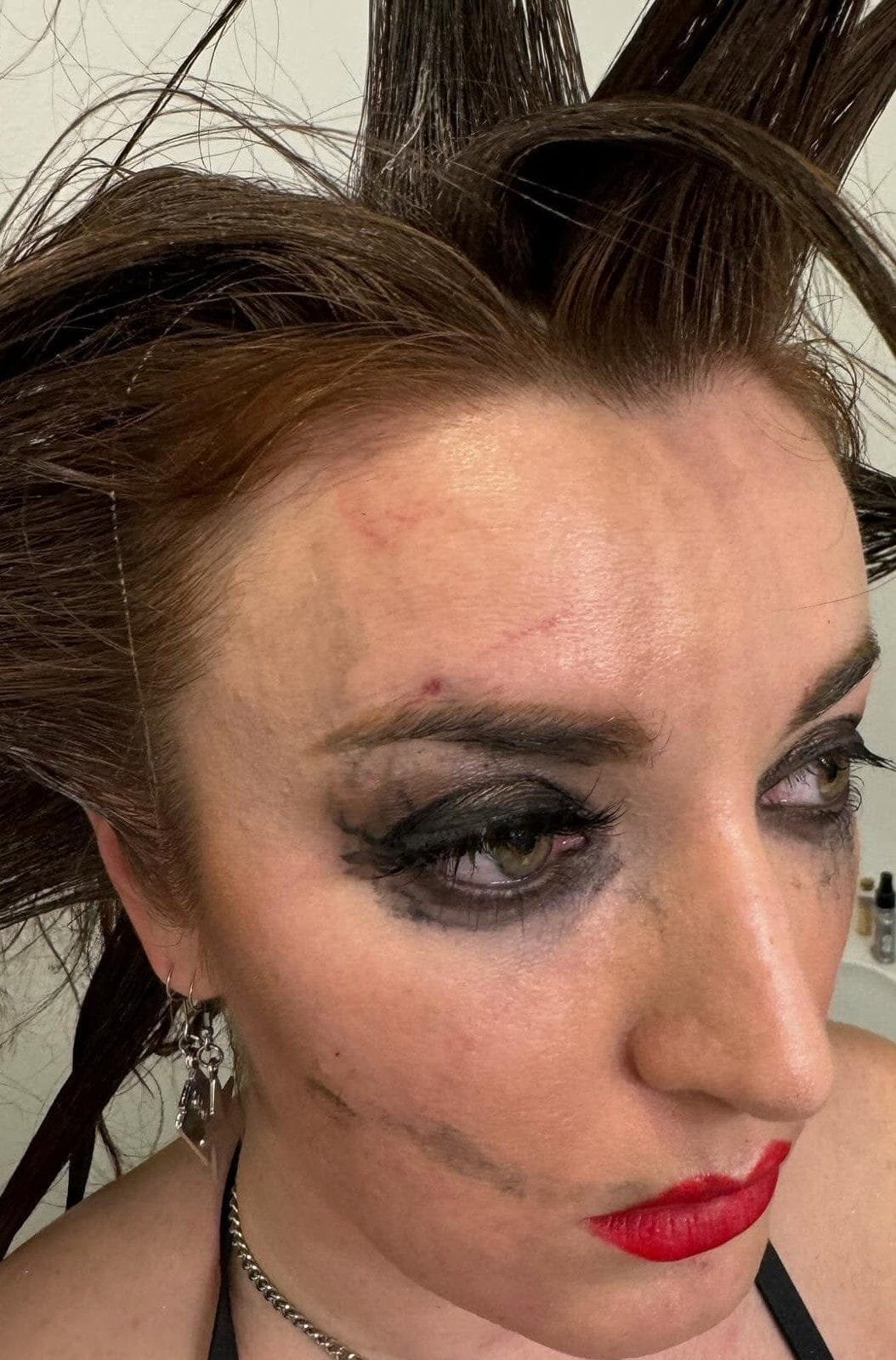
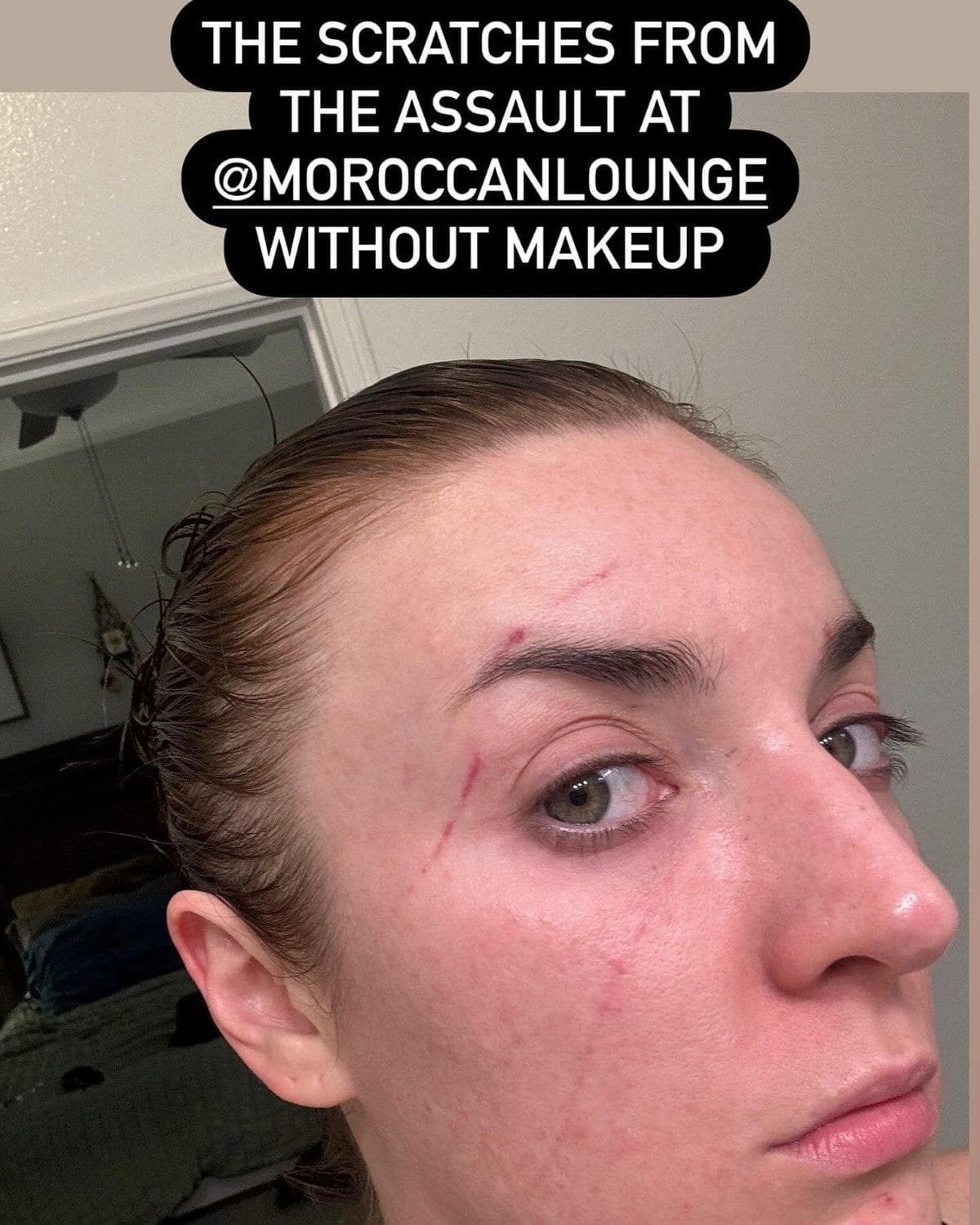
Not everyone piled on. One commenter asked how a woman described as barely able to stand could have carried out an attack like that. Days after the comment about stabbing, another wrote, “I don’t think she deserves to have violence committed against her,” and called fights over hairstyles “pretty dumb.”
As with Las Vegas, the two accounts share a frame: a confrontation in the women’s restroom, a boyfriend who came in, several men who went after him, a fight that moved out to the bar. They split over who started it and what the boyfriend did when he got there. The stickers, the drink, and the missing security come only from Erin; the other account doesn’t dispute them so much as leave them out. No police report, news story, venue statement, or video of the night has ever surfaced.
Eighteen months later, the thread added a new claim: that she had made up an allegation of sexual assault. In her videos about the night, she made no such allegation. The word she used, every time, was “assaulted,” and what she described was a beating.
AFTER
She knew how fast the story would travel, and that night she posted a video “to at least have an opportunity to speak my narrative.” She was right to hurry. “When I spoke out about it online,” she said later, “I was cancelled afterwards and called a liar.” The hostility went on for months, until she turned off comments on all her social accounts.
In July, she skipped Rebellion, the UK festival she had once called “like family,” because she was “not comfortable being in a large crowd.” To the people celebrating her absence, she said, “Yay, gatekeeping works, we got her out,” and she added a warning: without people covering it, punk could become “just a relic.”
She and her boyfriend tried couples therapy, and it didn’t help much. That summer, they went looking for a reset on Guatemala’s Acatenango volcano, a thirty-six-hour climb carrying their own gear; getting through something that hard, she reasoned, would make everything else “feel so small.” When she stopped on the way up to touch up her makeup, other hikers laughed at her. “You can take the girl out of LA,” she said, “but you can’t take the LA out of the girl.”
Some months after the fight, she posted a short clip from behind the wheel of her 1963 Ford Falcon, “with my hair up for the 1st time since my assault.”
By September 2025, she had retired the spikes for good and stepped away from the show. “It was just getting too dangerous,” she said; organizers “didn’t want to provide me with security.” It hurt. “It does bum me out, having to give up something I loved so much.” Asked whether she missed punk shows, she said, “Yes. But do I miss being mistreated and abused while I was in a working environment or just attending as a patron enjoying the shows? No, I don’t.” Then: “In my experience, the punk scene is incredibly misogynistic. I do not think I would have had as hard of a time as I did if I was a man doing what I was doing.”
A year later, the three most-watched videos on her YouTube channel were old footage of the spikes.
THE LAW
The thread that asked whether she was a poser is still there, its question unanswered. Between a forum post in 2020 and a restroom in 2024, the argument had become a thing you could hold: a sticker with her face on it, carried to a show headlined by a band whose singer co-founded an anarchist center.
Two springs before that night, a podcast interviewer had asked her how she found punk in the first place.
“I got into punk when I was 16 years old because I didn’t fit in anywhere else,” she said, “and it was somewhere that I felt that I fit in.” Then, without a pause: “And now I don’t even fit in. I’m an outcast.”
The short version
- Erin Micklow, a pin-up model who became an interviewer on the punk scene, wore liberty spikes from around 2012 until 2025. Videos about the spikes, fewer than one in thirty of her YouTube Shorts, drew nearly two of every three views.
- Parts of the scene called her a poser. In 2018, by her account, she was banned from Punk Rock Bowling in Las Vegas; her critics tell it differently. In April 2024, after a confrontation in the women’s restroom at the Moroccan Lounge in Los Angeles, she said she had been attacked; anonymous posters said she started it. No police report, venue statement or video of either night has surfaced.
- In September 2025 she retired the spikes, saying it had become too dangerous. A year later, her most-watched videos were still old footage of the spikes. “And now I don’t even fit in,” she said. “I’m an outcast.”
This story draws on Erin Micklow’s own interviews, livestreams, and videos from 2017 to 2026, on press coverage, and on public records. Social-media figures come from a count of her public YouTube, TikTok, and Instagram posts in October 2026.